
Prior to this year’s Fifa World Cup only three players have ever scored ten goals at a single tournament, and none since 1970. Frenchman Kylian Mbappé became the fourth, finishing on ten and winning a second Golden Boot. The Argentinian, Lionel Messi, scored eight, while Spain ultimately lifted the trophy. The tournament expanded, but the familiar names dominated.
In wagering, recreational money clusters around familiar names and favoured outcomes. When they all land together, the liability compounds. A favourite-friendly run of NFL results in late 2024 cost FanDuel’s parent, Flutter, an estimated $438 million in gross gaming revenue.
Parlays magnify that concentration. As we covered in an earlier note, punters like multis because a small stake can become a payday. Bookmakers like them because bundling the legs into one price makes the margin difficult to observe.
Open competition
Parlays became the sportsbook’s best product by pairing recreational demand with exceptional economics. Across Illinois, New Jersey and Colorado, they accounted for around 27% of money wagered but 56% of sportsbook revenue, according to The Wall Street Journal.
Operators carry licences, taxes, compliance, promotions, market-access payments and supplier revenue shares. That cost structure favours high-margin, price-insensitive bets. Parlays are exactly that bet.
For years the product looked untouchable. Then, on 29 September 2025, Kalshi launched Combos. The next day DraftKings fell 12% and Flutter 10%, although the product had barely traded. The industry’s highest-margin product had entered a structure where independent market makers compete for every order and take the other side of customer positions.
Prediction markets have also reached customers in states such as California and Texas, two of the largest states where online sports betting remains prohibited. Whether that access survives state challenges, or sports-related prediction markets survive them at all, is contested. The demand is not.
The scale
Bank of America estimates Kalshi processed roughly $125 million per World Cup match. On a recent Sunday without a major fixture, it still turned over about $945 million in volume (Ticker Tracker). Exchange volume counts both sides of every contract at face value, so these are notional figures rather than sportsbook handle or revenue.
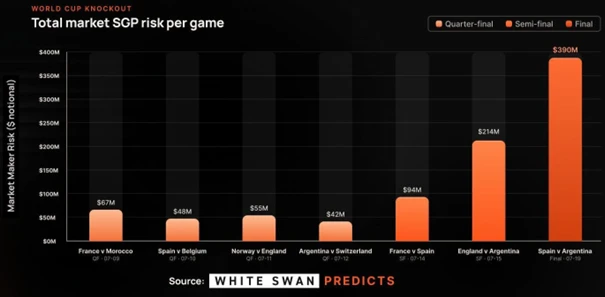
Same-game parlay (SGP) risk per match during the World Cup, on Kalshi alone. Risk here is the maximum a market maker must pay out if every leg of a combo lands. Source: White Swan Predicts
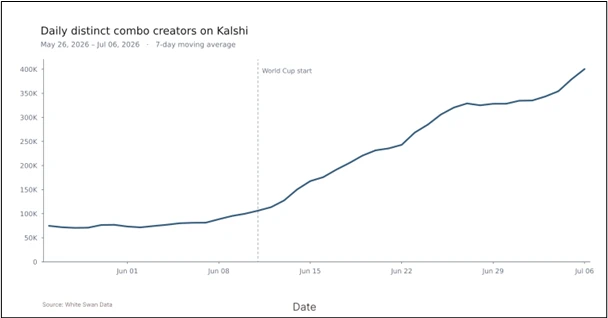
Kalshi’s daily combo creators rose from about 100,000 at the World Cup’s opening to nearly 400,000 by 6 July. (Seven-day moving average.) Source: White Swan Predicts
All roads lead to the NFL, which drove the first step-change in prediction market sports volume last season. This time, the product, liquidity and distribution are further advanced. For the opening week of the 2026 season, White Swan estimates that Kalshi alone will carry around $8 billion in maker risk.
An auction for risk
A sportsbook sets the price, manages risk across its book and decides whether to accept a bet. On an exchange, the customer builds a combo and submits a “request for quote”. Competing market makers respond with prices and the best quote wins. If accepted, the maker takes the other side and posts its maximum possible loss as collateral until settlement.
A customer might request England to win, Kane to score and over 2.5 goals. To the customer, it still feels like an accumulator. Behind the app, it is an auction for risk.
Prediction contracts now appear inside fintech, crypto and fantasy apps. That distribution reaches a vast retail audience, but every combo still needs someone to price it. The exchange supplies the distribution; the market maker supplies the balance sheet and the price.
Pricing the risk
Capital limits how much business a maker can accept. At a parlay price of 17/1 (18.0), every $1 of customer stake locks $17 of collateral until settlement. An outright can tie up that capital for weeks; a same-day combo can release it within hours. Returns therefore depend not only on pricing edge, but also on how efficiently capital turns over.
Competition is also key. Offer too short a price and the order goes elsewhere. Quote too big, and the sharp money picks you off. A sportsbook sets its own parlay margin; a maker on an exchange earns only what survives competition.
Correlation creates the modelling challenge. Outcomes within a match are linked. If France win comfortably, Mbappé is more likely to have scored and over 2.5 goals is more likely to have landed. A maker must measure how each outcome changes the probability of the others across thousands of combinations, in real time. Copying sportsbook prices is not enough because they already include the bookmaker’s margin and its commercial choices.
Market makers also tend to short the same public favourites, so a single result can settle thousands of related combinations at once. The job is not pricing each leg in isolation, but the whole distribution.
The opportunity
Financial market makers bring capital, execution infrastructure and latency management, but often lack specialist sports models. Professional betting syndicates have spent decades pricing sport, modelling correlation and managing risk across thousands of markets. Given capital, they are better placed than generic trading firms to capture value in prediction-market combos.
Waterhouse VC is working with one of the world’s leading professional betting syndicates to address the opportunity. The syndicate combines decades of experience pricing complex wagering risk with proprietary sports models and exchange-native trading infrastructure. Capital without pricing expertise gets picked off; pricing expertise without capital cannot scale.
Every quote must be fully collateralised, so more capital means more capacity to quote, and the room to deploy that pricing edge across more markets and at greater scale.
在今年Fifa世界杯之前,历史上仅有三位球员在单届赛事中打入十球,且自1970年以来再无来者。法国人Kylian Mbappé成为第四位,最终以十球收官并第二次赢得金靴奖。阿根廷人Lionel Messi打入八球,而西班牙最终捧起奖杯。赛事扩军了,但主导者仍是那些熟悉的名字。
在投注领域,休闲资金总是聚集在熟悉的名字和热门结果上。当它们同时命中时,赔付责任便会叠加。2024年末一段利好热门的NFL赛果走势,令FanDuel的母公司Flutter损失了约4.38亿美元的博彩总收入。
串关放大了这种集中度。正如我们在早前一篇报告中所提及的,投注者喜欢多串一,因为小额投注可能变成一笔可观收益。博彩公司也喜欢它们,因为将各腿打包成一个价格,使得利润率难以被察觉。
公开竞争
串关通过将休闲需求与卓越的经济效益相结合,成为体育博彩的最佳产品。据《华尔街日报》报道,在伊利诺伊州、新泽西州和科罗拉多州,串关约占投注金额的27%,却贡献了体育博彩收入的56%。
运营商承担着牌照、税费、合规、促销、市场准入费用以及供应商收入分成。这种成本结构有利于高利润率、对价格不敏感的投注。串关正是这样的投注。
多年来,这一产品看似无懈可击。然而,2025年9月29日,Kalshi推出了Combos。次日,DraftKings下跌12%,Flutter下跌10%,尽管该产品几乎尚未开始交易。行业利润率最高的产品,进入了一个由独立做市商为每一笔订单竞争、并承接客户头寸另一方的结构之中。
预测市场也已触达加利福尼亚州和德克萨斯州等州的客户,这两个最大的州仍禁止在线体育博彩。这种准入能否经受住各州的挑战,或者体育相关的预测市场能否整体存续,仍存争议。但需求是毋庸置疑的。
规模
美国银行估计,Kalshi在每场世界杯比赛期间处理了约1.25亿美元。在最近一个没有重大赛事的周日,其交易额仍约为9.45亿美元(Ticker Tracker)。交易所交易量按面值计算每份合约的双方,因此这些是名义数字,而非体育博彩的投注额或收入。
世界杯期间每场比赛的同场串关(SGP)风险,仅Kalshi平台。此处的风险是指若一个组合的每一腿都命中,做市商必须支付的最高金额。来源:White Swan Predicts
Kalshi的每日组合创建者从世界杯开幕时的约10万,上升至7月6日的近40万。(七日移动平均值。)来源:White Swan Predicts
条条大路通向NFL,上个赛季它推动了预测市场体育交易量的第一次阶跃式变化。这一次,产品、流动性和分销都更为先进。对于2026赛季的开幕周,White Swan估计仅Kalshi一家就将承担约80亿美元的做市商风险。
风险的拍卖
体育博彩公司设定价格,在其盘口上管理风险,并决定是否接受一笔投注。在交易所,客户构建一个组合并提交“报价请求”。相互竞争的做市商给出价格,最优报价胜出。若被接受,做市商承接另一方,并将其最大可能损失作为抵押品,直至结算。
客户可能请求英格兰获胜、Kane进球以及总进球数超过2.5球。对客户而言,这仍感觉像是一个累积投注。在应用背后,这是一场风险的拍卖。
预测合约如今出现在金融科技、加密货币和梦幻体育应用中。这种分销触达了庞大的零售受众,但每个组合仍需要有人为其定价。交易所提供分销;做市商提供资产负债表和价格。
为风险定价
资本限制了做市商能承接多少业务。在17/1(18.0)的串关价格下,客户每投注1美元,就会锁定17美元的抵押品直至结算。一个独赢盘可能占用该资本数周;一个当日组合则可在数小时内释放。因此,回报不仅取决于定价优势,还取决于资本周转的效率。
竞争同样关键。报价太低,订单就会流向别处。报价太高,就会被精明资金盯上。体育博彩公司自行设定串关利润率;交易所上的做市商只能赚取在竞争中幸存下来的部分。
相关性带来了建模挑战。一场比赛内的各项结果是相互关联的。如果法国轻松获胜,Mbappé更有可能取得进球,总进球数超过2.5球也更有可能命中。做市商必须实时衡量在数千种组合中,每个结果如何改变其他结果的概率。照搬体育博彩公司的价格是不够的,因为它们已经包含了博彩公司的利润率及其商业选择。
做市商也往往做空相同的公众热门,因此单一结果可能同时结算数千个相关组合。这项工作不是孤立地为每一腿定价,而是为整个分布定价。
机遇
金融市场做市商带来资本、执行基础设施和延迟管理,但往往缺乏专业的体育模型。职业博彩集团花费了数十年为体育定价、建模相关性并在数千个市场中管理风险。有了资本,他们比一般交易公司更有能力在预测市场组合中捕捉价值。
Waterhouse VC正与全球领先的职业博彩集团之一合作,以把握这一机遇。该集团将数十年为复杂投注风险定价的经验,与专有体育模型和交易所原生交易基础设施相结合。没有定价专长的资本会被收割;没有资本的定价专长无法规模化。
每一笔报价都必须完全抵押,因此资本越多,报价能力越强,也就有更大空间在更多市场、以更大规模部署这种定价优势。