
Lottomatica remains the Italian online market leader, but New York-based investment bank Jefferies believes its position faces a growing challenge from the combined might of Flutter’s Sisal and SNAI brands. The latest deep dive from the analysts puts Lottomatica at 30% of Italian online GGR in Q1, with Flutter already close behind on 27%.
That gap makes SNAI’s performance under Flutter ownership potentially decisive. Flutter’s previous Italian acquisition provides the obvious template: since buying Sisal in August 2022, it has increased the brand’s online GGR share from around 10% to 13%, with roughly three percentage points gained across both online sports betting and iGaming.
SNAI has travelled in the opposite direction. Jefferies calculates that it has lost around four percentage points of online share over recent years. If Flutter can merely recover that lost ground, it could be enough to propel the group past Lottomatica.
“Flutter boasts a track record of gaining the leading market share in almost every targeted territory,” Jefferies noted, suggesting Italy’s market-share evolution will become a key focus over coming quarters.
The opportunity matters because Italy combines huge scale with an unusually long online runway. Jefferies estimates 2025 gambling GGR at €22.6 billion, making it Europe’s largest market, while online penetration remains just 28%, versus 61% in the UK. It forecasts Italian online GGR growing at a whole 9% CAGR between 2025 and 2030.
Moreover, Italy’s advertising restrictions favour established omnichannel businesses with strong brands and retail estates. The new concession regime has also reduced the number of online licences from 81 to 52, potentially accelerating the shift towards the largest operators.
The Flutter playbook
Last week’s Flutter Q2 call provided the first significant evidence that its SNAI strategy may be gaining traction.
CEO Peter Jackson said Italy was continuing to deliver “exceptional levels of growth” across sportsbook and iGaming, with Flutter’s revenue performance outpacing the wider market.
Importantly, that came despite some self-inflicted disruption. Flutter completed the migration of SNAI onto its platform in April, causing what Jackson described as a “brief period of share loss”.
But the subsequent recovery appears to have been sharp. “Performance recovered strongly in June as customers embraced a significantly expanded product offering, with AMPs increasing 30% in June and strong parlay penetration during the World Cup,” Jackson said.
The timing is significant. Jefferies’ market data, running through June, showed SNAI’s OSB and iGaming shares still declining and said there was “no material sign” yet of an inflection. But its report also identified completion of the platform migration as the potential catalyst for a turnaround.
Flutter is effectively arguing that this inflection has now begun.
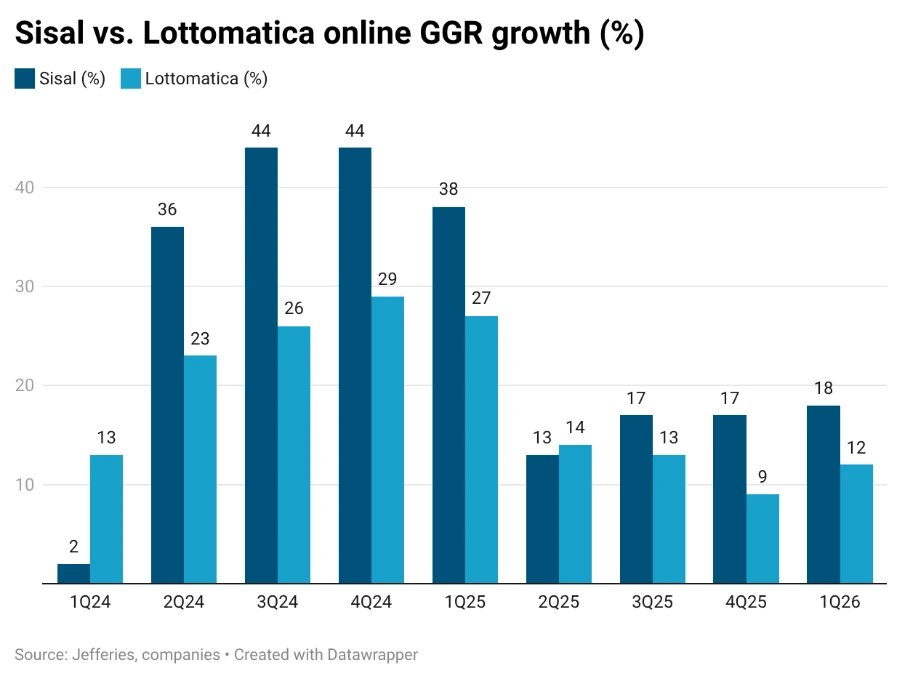
The historical Sisal comparison strengthens that case. Jefferies said Sisal has outgrown Lottomatica’s online business in seven of the past eight quarters under Flutter ownership and has beaten Lottomatica in iGaming growth in each of the past eight.
SNAI also brings something Sisal alone could not: substantially greater retail scale. Jefferies estimates acquiring SNAI lifted Flutter from around 20% to 27% of online GGR, while increasing its retail sports betting share from 12% to 32%. In a market where retail presence provides an important customer-acquisition advantage, that is a powerful combination.
Lottomatica isn’t standing still
Yet any suggestion that Flutter has a clear path to leadership needs tempering by Lottomatica’s own performance.
CEO Guglielmo Angelozzi told analysts that the Italian online market grew 12% in Q2, accelerating to 19% in June, while Lottomatica continued to gain share across sports, iGaming and overall online.
“In a mix of organic growth and M&A, we’ve gone from a marginal operator to the largest operator in the market,” he said.
Online revenue increased 24% in Q2 and 25% on a normalised basis, while online adjusted EBITDA margins reached 58% in H1. Lottomatica therefore enters the fight from a position of considerable strength.
It also has its own migration success story. Planetwin365’s sports share has moved above its pre-migration level, with CFO Laurence Van Lancker saying it had gained 0.2 percentage points, while iGaming has recovered around half its lost ground.
That experience also informs Lottomatica’s attitude towards the escalating competition. The company repeatedly stressed that it will not pursue market share regardless of economics.
“The point is not only acquiring market share, but acquiring quality market share at a sustainable cost,” Angelozzi told analysts. Van Lancker similarly emphasised “profitable growth” and promotional discipline.
That arguably defines the coming battle. Lottomatica is attempting to defend leadership while preserving exceptionally high online profitability; Flutter is applying its global product and technology capabilities to two of Italy’s strongest brands, with SNAI offering the clearest incremental opportunity.
The early Flutter evidence is encouraging, but one month of 30% player growth is not yet proof that SNAI’s long-term market-share decline has been reversed.
If it has, however, the numbers look uncomfortable for Lottomatica. Jefferies’ data suggests Flutter does not need to invent a new Italian success story. It needs to repeat with SNAI what it has already achieved with Sisal.
Lottomatica仍是意大利在线市场的领导者,但总部位于纽约的投资银行Jefferies认为,其地位正面临Flutter旗下Sisal和SNAI品牌联合力量的日益严峻挑战。分析师的最新深度报告显示,Lottomatica在第一季度占意大利在线博彩总收入的30%,而Flutter已以27%紧随其后。
这一差距使得SNAI在Flutter旗下的表现可能具有决定性意义。Flutter此前的意大利收购提供了显而易见的模板:自2022年8月收购Sisal以来,它已将该品牌的在线博彩总收入份额从约10%提升至13%,在线体育博彩和iGaming合计增长约三个百分点。
SNAI则朝着相反方向发展。Jefferies计算,近年来它已失去约四个百分点的在线份额。如果Flutter仅能收复这些失地,就可能足以推动该集团超越Lottomatica。
Jefferies指出:“Flutter在几乎所有目标地区都拥有夺取领先市场份额的过往记录。”这表明意大利市场份额的演变将成为未来几个季度的关键焦点。
这一机遇之所以重要,是因为意大利兼具巨大规模和异常漫长的在线增长跑道。Jefferies估计2025年博彩总收入为226亿欧元,使其成为欧洲最大的市场,而在线渗透率仅为28%,相比之下英国为61%。它预测2025年至2030年间意大利在线博彩总收入将以9%的复合年增长率增长。
此外,意大利的广告限制有利于拥有强大品牌和零售网络的成熟全渠道企业。新的特许经营制度还将在线牌照数量从81个减少至52个,可能加速向最大运营商的转移。
Flutter的制胜法则
上周的Flutter第二季度电话会议提供了首个重要证据,表明其SNAI战略可能正在获得 traction。
首席执行官Peter Jackson表示,意大利在体育博彩和iGaming领域继续实现“异常高的增长水平”,Flutter的收入表现超过了整体市场。
重要的是,这还是在经历了一些自身造成的中断之后实现的。Flutter于4月完成了SNAI向其平台的迁移,导致Jackson所描述的“短暂份额流失期”。
但随后的复苏似乎十分迅猛。Jackson表示:“6月份业绩强劲反弹,客户接受了大幅扩展的产品组合,6月活跃月度玩家增长30%,世界杯期间串关渗透率强劲。”
时机至关重要。Jefferies截至6月的市场数据显示,SNAI的在线体育博彩和iGaming份额仍在下降,并表示尚未出现“实质性拐点迹象”。但其报告也指出,平台迁移的完成可能是扭转局面的潜在催化剂。
Flutter实际上是在主张这一拐点已经开始。
历史上与Sisal的对比强化了这一论点。Jefferies表示,在Flutter旗下,Sisal在过去八个季度中有七个季度的在线业务增速超过Lottomatica,并在过去八个季度中的每一个季度都在iGaming增长方面击败了Lottomatica。
SNAI还带来了Sisal单独无法提供的东西:大幅增加的零售规模。Jefferies估计,收购SNAI使Flutter的在线博彩总收入份额从约20%提升至27%,同时将其零售体育博彩份额从12%提升至32%。在一个零售业务提供重要客户获取优势的市场中,这是一个强大的组合。
Lottomatica并未止步不前
然而,任何认为Flutter有明确通往领导地位之路的说法,都需要以Lottomatica自身的表现来加以平衡。
首席执行官Guglielmo Angelozzi告诉分析师,意大利在线市场第二季度增长12%,6月加速至19%,而Lottomatica在体育、iGaming和整体在线业务中持续获得份额。
他表示:“通过有机增长和并购的结合,我们已经从一家边缘运营商发展成为市场上最大的运营商。”
第二季度在线收入增长24%,按正常化基准增长25%,而上半年在线调整后EBITDA利润率达到58%。因此,Lottomatica从相当强势的地位进入这场竞争。
它也有自己的迁移成功案例。Planetwin365的体育份额已超过迁移前水平,首席财务官Laurence Van Lancker表示其增长了0.2个百分点,而iGaming已收复约一半失地。
这一经验也影响了Lottomatica对不断升级的竞争的态度。该公司反复强调,不会不顾经济效益地追求市场份额。
Angelozzi告诉分析师:“关键不仅在于获取市场份额,还在于以可持续的成本获取高质量的市场份额。”Van Lancker同样强调了“盈利性增长”和促销纪律。
这可以说定义了即将到来的战斗。Lottomatica正试图在保持异常高的在线盈利能力的同时捍卫领导地位;Flutter正将其全球产品和技术能力应用于意大利两个最强大的品牌,其中SNAI提供了最明显的增量机会。
Flutter的早期证据令人鼓舞,但一个月的30%玩家增长尚不能证明SNAI长期市场份额下滑已被逆转。
然而,如果确实如此,这些数字对Lottomatica来说将令人不安。Jefferies的数据表明,Flutter不需要创造一个新的意大利成功故事。它只需要在SNAI上重复它已经在Sisal上取得的成就。