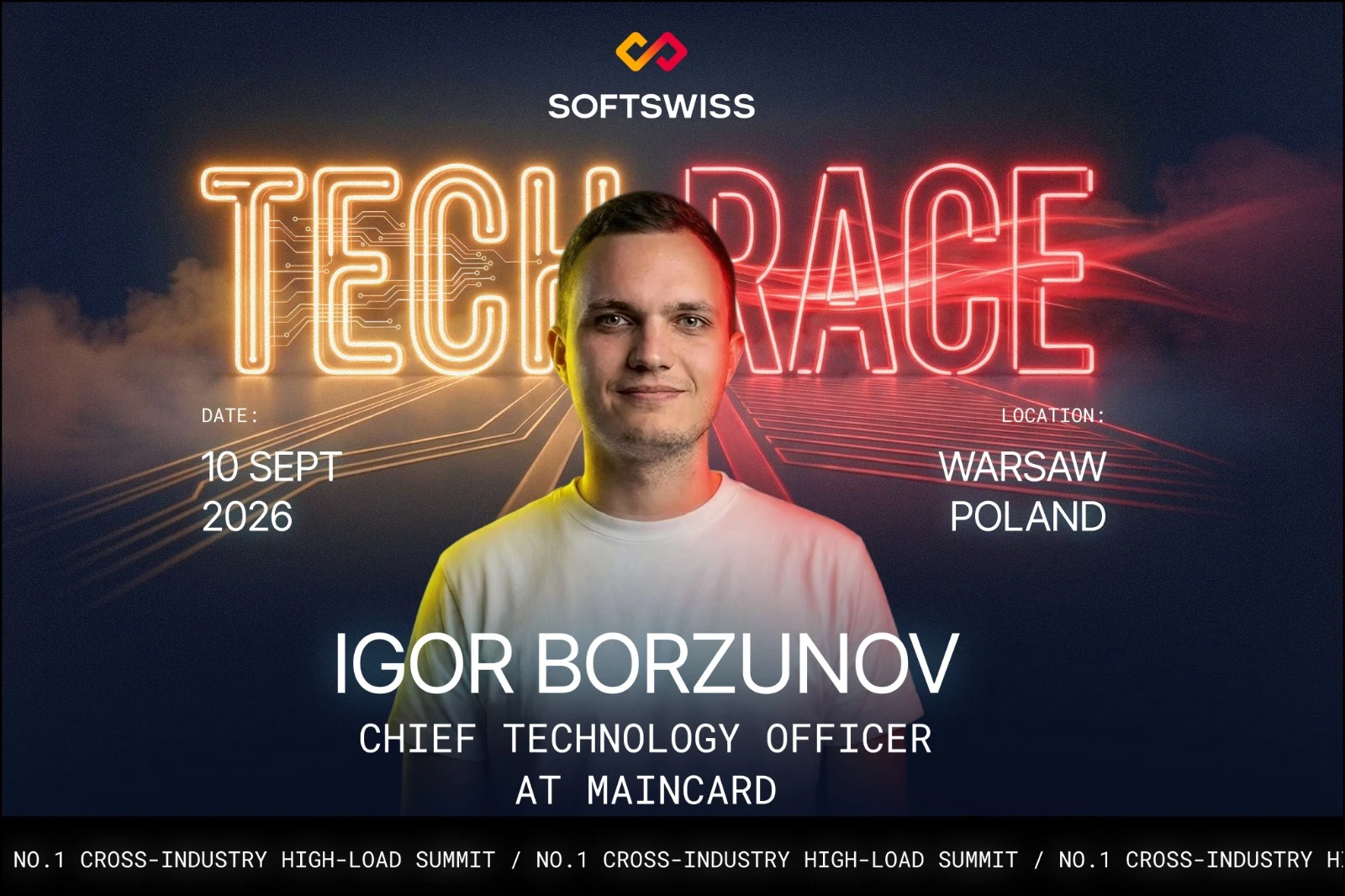
Igor Borzunov has spent over 10 years building high-load enterprise systems. Today, he is CTO at Maincard – a no-code platform that lets operators launch a branded iGaming site in under 30 minutes.
At Tech Race Summit on 10 September in Warsaw, Igor will present “From 3am pages to 30 seconds: Building an autonomous AI ops agent” – a session on what it actually takes to give an AI agent access to live production environments.
We spoke with Igor about AI in production, the real cost of scaling operations and why AI agent autonomy is a dial, not a switch.
Learn more about Tech Race Summit.
1. Engineering leaders are debating how AI is changing software development. Do you think we’re currently overestimating AI’s capabilities, or underestimating how quickly it will reshape engineering teams?
Honestly, both at once.
We overestimate what AI can do unsupervised. Every demo looks magical, but when you put it in front of real production, it confidently does the wrong thing. Our agent works well precisely because we spent most of our effort on the boring parts: guardrails, approval tiers and knowing when to stop and ask a human.
And at the same time, we badly underestimate the speed of the team change. A year ago, “give an AI access to production” sounded reckless at best. Today, it triages our night incidents.
That gap is opening faster than most leaders think. The engineers who learn to build and supervise these systems will simply outrun the ones who treat AI as a fancier autocomplete.
2. Maincard powers more than 40 casino brands from a single platform. What’s one lesson about scaling technology that you think the wider iGaming industry still underestimates?
That the hard part isn’t scaling the code, it’s scaling the operations. Making one codebase serve dozens of brands is a solved engineering problem: shared core, per-brand configuration, stable continuous integration and delivery.
What nobody warns you about is that every new brand multiplies the operational surface. More payment routes, more provider integrations, more things that can quietly break at 3am. Your platform scales linearly, and your on-call pain scales worse than that.
So my lesson is: invest in operations tooling as early and as seriously as you invest in features. We got 40+ brands running with an ops team of about 20 people, and that’s only possible because we treat operations as an engineering problem, not as a cost centre you staff with more bodies.
3. You often say that a 3am production incident isn’t necessarily a sign of bad engineering. That sounds counterintuitive. What do most companies get wrong about operational excellence?
They optimise for the wrong number. Most companies chase incident count: zero incidents, green dashboards, everyone happy. But if you’re integrating dozens of external providers who change behaviour without warning, incidents are just physics. A provider tweaks a webhook format on a Friday night, and no test suite in the world saves you.
The metric that actually matters is time to diagnosis. When resolving a failure takes 30 seconds with proper tooling instead of 25 minutes manually, you turn a potential multi-brand crisis into a non-event.
The second thing companies get wrong is blame. If every night incident turns into “whose fault is this?”, people start hiding problems instead of fixing the system. The fix lies in tooling, not in assigning blame.
4. The iGaming industry has become incredibly good at launching new brands. In your view, has launching become too easy, and has operating those brands become the real competitive advantage?
Yes, and I say that as someone who made launching easy. Our constructor turned a casino launch from a months-long project into routine. But that’s exactly the point: when everyone can launch, launching stops being an advantage. The market is full of brands that went live fast and then slowly rot, because nobody budgeted for keeping them healthy. Payments degrade, bonuses misfire, players churn.
Operating well is much harder to copy than launching. A competitor can clone your landing page in a week. What they can’t clone is the discipline and tooling that keeps 40+ brands healthy around the clock with a small team.
So yes, the competitive advantage has moved from “can you launch?” to “can you run it well with good uptime?”.
5. You’ve given AI visibility into live production, but not unlimited authority. Was the hardest challenge technical, organisational, or simply convincing people to trust the system?
Trust, without question. The technical part was the fast part: wiring an agent into MySQL, Kubernetes, Grafana and the rest is weeks of work for a good team.
The real design problem was human. That’s why our approval model has tiers: reading is free, notifications are logged, restarting a pod requires one approval and anything that touches money requires two humans to sign off. Half of that exists for safety, and, honestly, the other half exists so that people can watch the agent work and gradually relax.
We started read-only. The agent could only look and explain. Once engineers saw it correctly diagnose incidents they’d have spent half an hour on, they started asking us to let it do more. This way, trust was earned incident by incident. But we still have one hard rule: the agent has to show its reasoning.
6. Looking beyond Maincard, what technology shift do you believe will have the biggest impact on online casinos over the next three to five years and why?
I’d say AI moving from the chat window into the machinery. Right now, most of the industry uses AI as a support chatbot or a marketing copy generator, which is the least interesting application imaginable.
The real shift is agents operating inside the platform: monitoring payments, detecting AML anomalies, tuning infrastructure, and handling the operational load that today overwhelms human teams. In three to five years, I expect the gap between operators to be defined by this. Same games, same providers, similar bonuses, but one company runs 40 brands with 20 people and reacts in seconds, while another needs 200 people and reacts in hours.
Regulation will push in the same direction: compliance is pattern-matching at scale, and machines are simply better at watching everything all the time.
7. The iGaming industry is often seen as a fast follower rather than a technology pioneer. Looking outside the sector, which company or industry do you think iGaming should be learning from today, and what are we still missing?
Fintech, without hesitation – that’s where I started as a tech specialist. They live under the same conditions we do: real money, heavy regulation, zero tolerance for downtime. And they answered that pressure by turning reliability into an engineering discipline: systems reliability practices, error budgets, blameless postmortems, observability as a first-class product.
iGaming mostly answered it by hiring bigger support teams. What we’re still missing is the mindset that operations is a product you build, not a shift you staff.
The other lesson from big tech is platform thinking: build the boring shared core once, properly, and let brands be thin layers on top. That’s what our constructor is. It’s not a new idea, we borrowed it shamelessly and it works.
8. At Tech Race Summit you’ll be discussing what happens when AI moves beyond copilots and starts operating inside production environments. If attendees remember just one idea from your session, what do you hope it will be?
That autonomy is a dial, not a switch. The debate always gets framed as “do you trust AI in production, yes or no?”, and that framing is why most companies are stuck.
You don’t hand an agent the keys to everything on day one, and you don’t lock it in a chat window forever either. You give it tiered access: start with read-only diagnosis, let it earn the right to act, keep humans on the actions that matter, always two of them where money moves. Build it that way, and the question stops being scary.
If people leave my session and stop asking “should we let AI into production?” and start asking “which tier do we start at?”, the talk did its job.
Ready to hear more from Igor and the rest of the Tech Race speaker lineup? Buy your tickets at techracesummit.com.
Igor Borzunov 花了十多年时间构建高负载企业系统。如今,他是 Maincard 的 CTO——这是一个无代码平台,让运营商能在 30 分钟内上线一个品牌化的 iGaming 网站。
在 9 月 10 日于华沙举行的 Tech Race Summit 上,Igor 将发表演讲“从凌晨 3 点的告警到 30 秒:构建自主 AI 运维代理”——这场演讲将探讨让 AI 代理访问实时生产环境究竟需要什么。
我们与 Igor 聊了聊生产环境中的 AI、扩展运营的真实成本,以及为什么 AI 代理的自主性是一个旋钮,而不是一个开关。
1. 工程负责人正在讨论 AI 如何改变软件开发。你认为我们目前是高估了 AI 的能力,还是低估了它将重塑工程团队的速度?
说实话,两者同时存在。
我们高估了 AI 在无人监督下能做的事。每个演示看起来都很神奇,但当你把它放到真实的生产环境中时,它会自信地做错事。我们的代理之所以运行良好,恰恰是因为我们把大部分精力花在了那些无聊的部分上:护栏、审批层级,以及知道何时停下来询问人类。
与此同时,我们又严重低估了团队变革的速度。一年前,“让 AI 访问生产环境”听起来充其量是鲁莽之举。而今天,它已经在为我们的夜间事件做初步分诊。
这个差距正在以比大多数领导者想象中更快的速度扩大。学会构建和监督这些系统的工程师,将直接超越那些把 AI 当作更花哨的自动补全工具的人。
2. Maincard 通过单一平台为 40 多个赌场品牌提供支持。关于扩展技术,你认为整个 iGaming 行业仍然低估了哪一个教训?
难的部分不是扩展代码,而是扩展运营。让一个代码库服务数十个品牌是一个已经解决的工程问题:共享核心、按品牌配置、稳定的持续集成与交付。
没有人警告你的是,每增加一个新品牌,运营面就会成倍扩大。更多的支付通道、更多的供应商集成、更多可能在凌晨 3 点悄悄出问题的地方。你的平台是线性扩展的,而你的待命痛苦扩展得比这更糟。
所以我的教训是:像投资功能一样,尽早且认真地投资运营工具。我们用大约 20 人的运维团队让 40 多个品牌运转起来,而这之所以可能,只是因为我们把运营当作一个工程问题,而不是一个靠增加人手来填补的成本中心。
3. 你经常说,凌晨 3 点的生产事故不一定是糟糕工程的标志。这听起来有违直觉。大多数公司在运营卓越方面做错了什么?
他们优化了错误的数字。大多数公司追求事故数量:零事故、绿色仪表盘、皆大欢喜。但如果你正在集成数十个会在毫无预警的情况下改变行为的外部供应商,事故就是物理规律。一个供应商在周五晚上调整了 webhook 格式,世界上任何测试套件都救不了你。
真正重要的指标是诊断时间。当借助合适的工具,解决一次故障只需 30 秒而不是手动花 25 分钟时,你就把一场潜在的多品牌危机变成了一件无关紧要的小事。
公司做错的第二件事是追责。如果每次夜间事故都变成“这是谁的错?”,人们就会开始隐藏问题,而不是修复系统。解决办法在于工具,而不在于追究责任。
4. iGaming 行业在推出新品牌方面已经变得极其擅长。在你看来,推出品牌是否变得太容易了,而运营这些品牌是否已成为真正的竞争优势?
是的,而我作为一个让推出变得容易的人这么说。我们的构建器把赌场上线从长达数月的项目变成了例行公事。但这恰恰是重点:当人人都能推出时,推出就不再是一种优势。市场上充斥着那些快速上线、然后慢慢腐烂的品牌,因为没有人把保持它们健康运转列入预算。支付退化、奖金出错、玩家流失。
运营得好比推出更难被复制。竞争对手可以在一周内克隆你的落地页。他们无法克隆的是那种让 40 多个品牌在一支小团队手中全天候保持健康的纪律和工具。
所以是的,竞争优势已经从“你能推出吗?”转变为“你能以良好的正常运行时间把它运营好吗?”。
5. 你已经让 AI 能够查看实时生产环境,但没有给它无限的权限。最难的挑战是技术上的、组织上的,还是仅仅说服人们信任这个系统?
毫无疑问是信任。技术部分是快的部分:把一个代理接入 MySQL、Kubernetes、Grafana 等等,对一个优秀团队来说是几周的工作。
真正的设计问题是人的问题。这就是为什么我们的审批模型有层级:读取是自由的,通知会被记录,重启一个 pod 需要一次审批,而任何涉及资金的操作需要两个人签字批准。其中一半是为了安全,而说实话,另一半是为了让人们能够观察代理工作并逐渐放松下来。
我们从只读开始。代理只能查看和解释。一旦工程师看到它正确地诊断出他们本来要花半小时处理的事故,他们就开始要求我们让它做更多。这样,信任是一次次事故中赢得的。但我们仍然有一条硬性规则:代理必须展示它的推理过程。
6. 放眼 Maincard 之外,你认为未来三到五年内,哪种技术转变将对在线赌场产生最大影响,为什么?
我想说是 AI 从聊天窗口走进机器内部。现在,大多数行业把 AI 用作支持聊天机器人或营销文案生成器,这是能想象到的最无趣的应用。
真正的转变是代理在平台内部运作:监控支付、检测 AML 异常、调整基础设施,以及处理如今压垮人类团队的运营负载。在三到五年内,我预计运营商之间的差距将由此定义。同样的游戏、同样的供应商、类似的奖金,但一家公司用 20 人运营 40 个品牌并在几秒内做出反应,而另一家需要 200 人并在几小时内做出反应。
监管也会朝同一方向推动:合规就是大规模的模式匹配,而机器在时刻监视一切方面就是更强。
7. iGaming 行业通常被视为快速跟随者,而非技术先驱。放眼行业之外,你认为 iGaming 今天应该向哪家公司或哪个行业学习,而我们仍然缺少什么?
毫不犹豫是金融科技——那是我作为技术专家起步的地方。他们生活在与我们相同的条件下:真金白银、严格监管、对停机零容忍。而他们通过把可靠性变成一门工程学科来应对这种压力:系统可靠性实践、错误预算、无指责事后复盘、将可观测性作为一等产品。
iGaming 大多通过雇佣更大的支持团队来应对。我们仍然缺少的是这样一种心态:运营是你构建的产品,而不是你排班填补的轮班。
来自大型科技公司的另一个教训是平台思维:把无聊的共享核心一次性正确地构建好,让品牌成为其上的薄层。这就是我们的构建器。这不是什么新想法,我们毫不客气地借鉴了它,而且它行之有效。
8. 在 Tech Race Summit 上,你将讨论当 AI 超越副驾驶并开始在生产环境内部运作时会发生什么。如果与会者只能从你的演讲中记住一个观点,你希望那是什么?
自主性是一个旋钮,而不是一个开关。这场辩论总是被框定为“你信任生产环境中的 AI 吗,是还是否?”,而正是这种框定让大多数公司陷入困境。
你不会在第一天就把所有东西的钥匙交给一个代理,你也不会永远把它锁在聊天窗口里。你给它分层级的访问权限:从只读诊断开始,让它赢得行动的权利,在重要的操作上保留人类,在涉及资金流动的地方始终保留两个人。这样构建,问题就不再可怕了。
如果人们离开我的演讲后不再问“我们应该让 AI 进入生产环境吗?”,而是开始问“我们从哪一层开始?”,那这场演讲就完成了它的使命。
准备好听 Igor 和 Tech Race 其他演讲嘉宾的更多分享了吗?在 techracesummit.com 购买门票。